Assignment 2: Unit Conversion, Recipe and Instruction Classes
This assignment is preliminary content and is subject to change until the release date of the assignment.
Overview
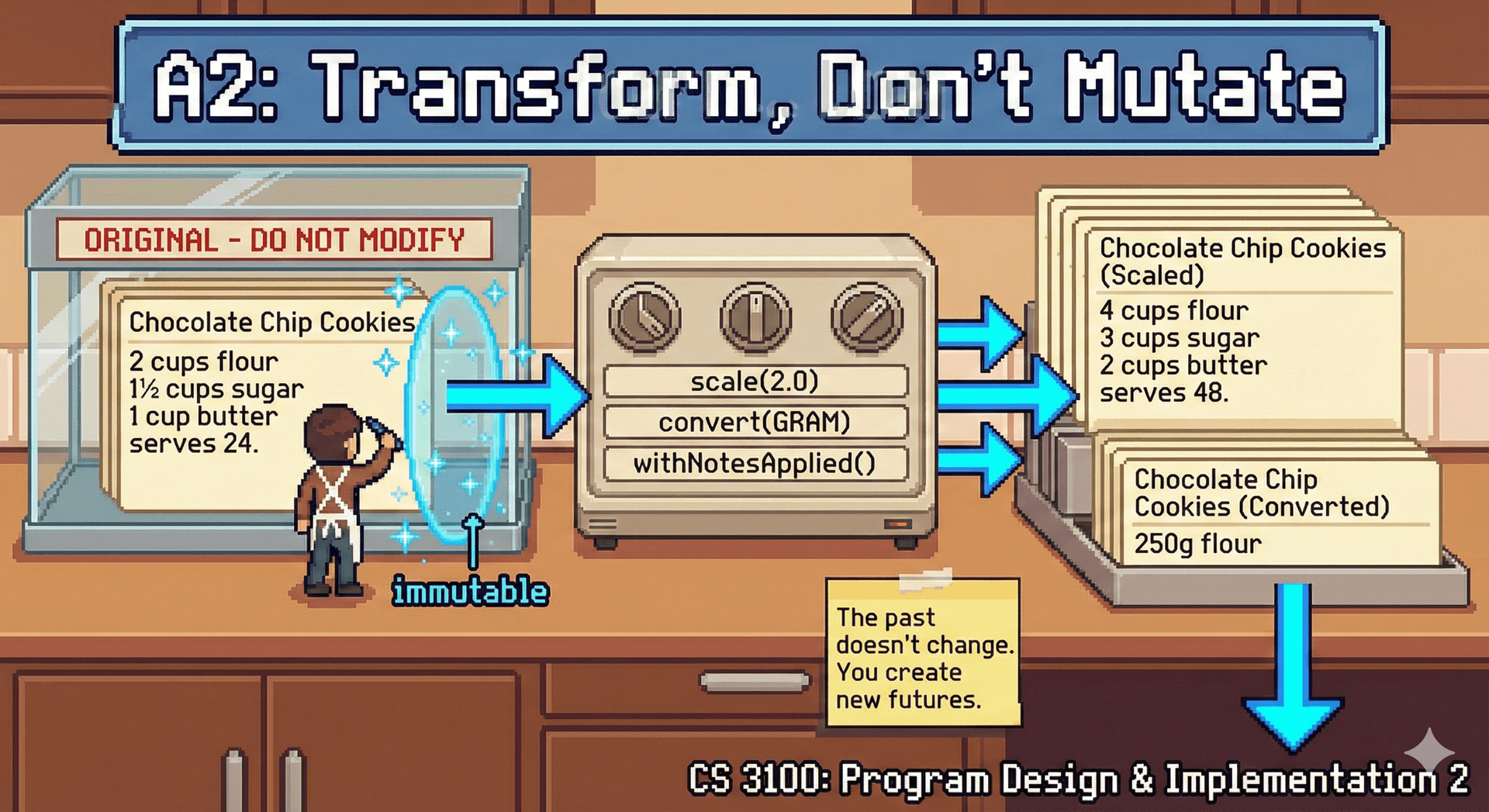
In this assignment, you'll expand the CookYourBooks domain model by implementing unit conversion, recipe scaling, and the core recipe structure. Building on Assignment 1's Quantity and Ingredient hierarchies, you'll create a flexible conversion system that supports standard metric/imperial conversions, ingredient-specific density conversions (like "1 cup flour = 125 grams"), and custom "house" overrides.
The conversion system presents rich design challenges: How do you represent conversion rules? How do you compose them when multiple sources (global defaults, recipe-specific, house overrides) might apply? How do you design for extensibility without over-engineering? These questions don't have single right answers—your design decisions and their justifications matter as much as your working code.
You'll also implement the Recipe, Instruction, and RecipeNote classes that form the backbone of the application. Recipes can be scaled (to serve more or fewer people) and converted (to different unit systems), with the order of these operations being caller-controlled.
Due: Thursday, January 29, 2026 at 11:59 PM Boston Time
Prerequisites: This assignment builds on the A1 solution (provided). You should be familiar with the Quantity, Ingredient, and Unit hierarchies from Assignment 1.
Learning Outcomes
By completing this assignment, you will demonstrate proficiency in:
- Designing for changeability by creating modular, loosely-coupled components (L7: Coupling and Cohesion)
- Applying information hiding to encapsulate design decisions that are likely to change (L6: Modularity and Information Hiding)
- Implementing immutable transformations that return new objects rather than mutating existing ones
- Designing method specifications with clear preconditions and postconditions (L4: Specifications and Contracts)
- Implementing
equals()andhashCode()correctly for value objects - Making principled design decisions and articulating their tradeoffs
AI Policy for This Assignment
AI coding assistants (such as GitHub Copilot, ChatGPT, Claude, etc.) should NOT be used for this assignment.
This assignment focuses on design decisions that require understanding tradeoffs—something that benefits from working through the problem yourself. You may:
- Use official Java documentation
- Consult your textbook and course materials
- Ask questions in office hours or on the course discussion board
- Discuss high-level approaches with classmates (but write your own code)
Report any AI usage in the Reflection section.
Technical Specifications
Domain Concepts
Unit Conversion
Unit conversion in cooking is more complex than simple mathematical ratios. Consider these scenarios:
- Standard conversions follow fixed ratios: 1 cup = 236.588 mL, 1 pound = 453.592 grams
- Ingredient-specific conversions account for density: 1 cup of flour ≠ 1 cup of honey in weight
- House overrides reflect personal preferences or equipment: "In my kitchen, 1 oz = 30 mL" (rounded for convenience)
Your conversion system must support all three, with this priority order (highest to lowest):
- House conversions - User-defined overrides that always take precedence
- Recipe-specific conversions - Conversions defined within a particular recipe
- Global conversions - Standard conversions available to all recipes
Conversions may span different dimensions when appropriate ingredient context is provided:
- Volume ↔ Volume (cups to mL): Always possible within same dimension
- Weight ↔ Weight (oz to grams): Always possible within same dimension
- Volume ↔ Weight (cups to grams): Requires ingredient-specific density information (e.g., "1 liter of water = 1 kilogram of water")
- Count ↔ Weight (whole eggs to grams): Requires ingredient-specific information
Impossible conversions (e.g., weight to volume without density information) should throw an IllegalArgumentException.
Recipe Scaling
Recipes can be scaled in two ways:
- By multiplier: Scale all quantities by a factor (e.g., 2x doubles everything)
- By ingredient target: Scale so that a specific ingredient reaches a target amount (e.g., "scale so I have 10 cups of flour" when the recipe calls for 2 cups → 5x multiplier)
Order of operations matters. Consider a recipe with "2 cups flour" that you want to:
- Scale by 2x → "4 cups flour"
- Convert to grams (at 125g/cup) → "500 grams flour"
vs.
- Convert to grams first → "250 grams flour"
- Scale by 2x → "500 grams flour"
With exact arithmetic, these are equivalent. But with rounding or fractional quantities, results may differ. The caller chooses whether to scale-then-convert or convert-then-scale.
Recipe Notes
A RecipeNote represents a modification or annotation to a recipe. Notes are functional transformations—when applied, they produce a new Recipe with the modification incorporated. Examples:
- "Double the garlic" → Scales a specific ingredient
- "Use olive oil instead of butter" → Substitutes an ingredient
- "Add 1 tsp vanilla" → Adds a new ingredient
- "Reduce baking time by 5 minutes at high altitude" → Modifies an instruction
Class Design
You must implement the following classes. Classes from A1 are shown in gray for context.
Invariants and Contracts
ConversionRule (record)
A record representing a single conversion rule between units. Uses Java's record feature for concise, immutable value objects.
public record ConversionRule(
    @NonNull Unit fromUnit,
    @NonNull Unit toUnit,
    double factor,
    @Nullable String ingredientName
) { ... }
Record Components:
fromUnit- The source unit for this conversion (never null)toUnit- The target unit for this conversion (never null)factor- The multiplication factor (e.g., 236.588 for cups→mL)ingredientName- If non-null, this rule only applies to this ingredient (case-insensitive)
Compact Constructor Validation:
fromUnitandtoUnitmust not be nullfactormust be positive (> 0)- Throws:
IllegalArgumentExceptionif validation fails
Methods:
-
public boolean canConvert(@NonNull Unit from, @NonNull Unit to, @Nullable String ingredient)- Returns
trueif this rule can convert fromfromtoto - If
ingredientNameis non-null, also checks thatingredientmatches (case-insensitive) - If
ingredientNameis null (generic rule), matches any ingredient
- Returns
-
public @NonNull Quantity convert(@NonNull Quantity quantity)- Preconditions:
quantity.getUnit()equalsfromUnit - Postconditions: Returns a new
Quantityof the same type as the input with converted amount andtoUnit. For example:ExactQuantity→ExactQuantitywithamount * factorRangeQuantity→RangeQuantitywithmin * factorandmax * factorFractionalQuantity→FractionalQuantity(apply factor to whole and fractional parts appropriately)
- Throws:
IllegalArgumentExceptionif precondition is violated
- Preconditions:
Example:
// Generic rule: cups to milliliters
var cupsToMl = new ConversionRule(Unit.CUP, Unit.MILLILITER, 236.588, null);

// Ingredient-specific rule: cups of flour to grams
var flourCupsToGrams = new ConversionRule(Unit.CUP, Unit.GRAM, 125.0, "all-purpose flour");

// Usage
cupsToMl.canConvert(Unit.CUP, Unit.MILLILITER, null);           // true
cupsToMl.canConvert(Unit.CUP, Unit.MILLILITER, "flour");        // true (generic rule)
flourCupsToGrams.canConvert(Unit.CUP, Unit.GRAM, "flour");      // false (name doesn't match exactly)
flourCupsToGrams.canConvert(Unit.CUP, Unit.GRAM, "all-purpose flour"); // true
StandardConversions (class)
Provides factory access to standard conversion rules. This class is provided by the instructor—you will use it but not implement it.
Methods:
static ConversionRule getRule(Unit from, Unit to)- Returns the standard rule for this conversion, ornullif none existsstatic List<ConversionRule> getAllRules()- Returns all standard conversion rules
Standard conversions are pre-computed for all unit pairs within the same dimension. This means:
- All volume ↔ volume conversions exist (cups ↔ tbsp ↔ tsp ↔ fl oz ↔ ml ↔ liters—every pair)
- All weight ↔ weight conversions exist (oz ↔ lb ↔ g ↔ kg—every pair)
You do NOT need to implement conversion chaining—StandardConversions provides direct rules for any within-dimension conversion.
Note: Standard conversions do NOT include:
- Volume ↔ weight conversions (require ingredient-specific density)
- Count ↔ weight/volume conversions (require ingredient-specific information)
- House unit conversions (
PINCH,DASH,HANDFUL,TO_TASTE)
ConversionRegistry (interface)
A collection of conversion rules with defined precedence. Registries are immutable—adding rules returns a new registry.
Methods:
-
@NonNull Quantity convert(@NonNull Quantity quantity, @NonNull Unit targetUnit)- Converts without ingredient context (for simple unit conversions)
- Searches rules in priority order to find an applicable rule
- Quantity types are preserved: converting a
RangeQuantityproduces aRangeQuantity, etc. - Throws:
IllegalArgumentExceptionif no applicable rule exists
-
@NonNull Quantity convert(@NonNull Quantity quantity, @NonNull Unit targetUnit, @Nullable String ingredientName)- Converts with ingredient context (enables density-based conversions)
- First searches for ingredient-specific rules, then falls back to generic rules
- Quantity types are preserved: converting a
RangeQuantityproduces aRangeQuantity, etc. - Throws:
IllegalArgumentExceptionif no applicable rule exists
-
@NonNull ConversionRegistry withRule(@NonNull ConversionRule rule)- Returns a new registry with the given rule added at highest priority
- The new rule takes precedence over all existing rules
-
@NonNull ConversionRegistry withRules(@NonNull Collection<ConversionRule> rules)- Returns a new registry with the given rules added at highest priority
- Rules in the collection maintain their relative order (first = highest priority among new rules)
LayeredConversionRegistry (class implements ConversionRegistry)
You must implement ConversionRegistry in a class named LayeredConversionRegistry.
Constructor:
public LayeredConversionRegistry()- Creates an empty registry with no rules
- Note: To get a registry with standard conversions, use
new LayeredConversionRegistry().withRules(StandardConversions.getAllRules())
Design Notes:
- The "layered" name suggests the immutable layering pattern: each
withRule()creates a new layer on top - How you implement the layering internally is up to you (list of rules, linked structure, etc.)
- Consider: How do you efficiently search through layers? How do you handle priority correctly?
Instruction (class)
Represents a single step in a recipe.
Constructor:
public Instruction(int stepNumber, @NonNull String text)- Preconditions:
stepNumbermust be positive (> 0)textmust not be null or blank
- Throws:
IllegalArgumentExceptionif preconditions violated - Postconditions: Creates an instruction with no ingredient references
- Preconditions:
Methods:
public int getStepNumber()- Returns the step numberpublic @NonNull String getText()- Returns the instruction textpublic @NonNull List<Ingredient> getReferencedIngredients()- Returns an unmodifiable list of referenced ingredients (may be empty)public @NonNull Instruction withIngredientReference(@NonNull Ingredient ingredient)- Returns a newInstructionwith the ingredient added to referencespublic @NonNull String toString()- Returns formatted string:"{stepNumber}. {text}"
Design Note: How you store ingredient references internally is up to you. The API requires only that you can add references and retrieve them.
Recipe Notes (Design Decision)
Recipe notes represent modifications or annotations that can be applied to a recipe. The RecipeBuilder provides a fixed API for adding notes, but how you represent and store notes internally is entirely up to you.
This is an intentional design decision left to students. Consider:
- Should notes be represented as objects? Records? An enum with data?
- Should there be a common interface/superclass, or can different note types be completely separate?
- How do you store notes in the Recipe? A list? A map? Multiple lists by type?
- How does
withNotesApplied()iterate through and apply them?
Your design will be evaluated on:
- Cohesion: Do related concepts stay together?
- Coupling: How tightly connected are note types to Recipe internals?
- Information hiding: Can you change the note representation without affecting the public API?
- Extensibility: How hard would it be to add a new note type?
Document your design decisions in your Javadoc and reflection.
Recipe (class or interface + implementation)
Represents a complete recipe. Recipes are immutable—all transformation methods return new Recipe objects.
You may implement Recipe as either:
- A concrete class with a public constructor, OR
- An interface with a package-private implementation class (accessed via
RecipeBuilder)
Required API:
@NonNull String getTitle()@NonNull Optional<Quantity> getServings()- Servings are optional; some recipes don't specify@NonNull List<Ingredient> getIngredients()- Unmodifiable list@NonNull List<Instruction> getInstructions()- Unmodifiable list@NonNull List<ConversionRule> getConversionRules()- Unmodifiable list of recipe-specific conversion rulesboolean hasNotes()- Returns true if there are unapplied notes@NonNull List<String> getNoteDescriptions()- Returns human-readable descriptions of all unapplied notes (for display/debugging)
Transformation Methods:
-
@NonNull Recipe scale(double factor)- Preconditions:
factormust be positive (> 0) - Postconditions: Returns new recipe with all
MeasuredIngredientquantities scaled byfactor. Servings (if present) are also scaled.VagueIngredients and instructions are unchanged. Quantity types are preserved: scaling aRangeQuantityproduces aRangeQuantity, scaling aFractionalQuantityproduces aFractionalQuantity, etc. - Throws:
IllegalArgumentExceptionif factor is not positive
- Preconditions:
-
@NonNull Recipe scaleToIngredient(@NonNull Ingredient ingredient, @NonNull Quantity targetAmount, @NonNull ConversionRegistry registry)- Preconditions:
ingredientmust be aMeasuredIngredientpresent in this recipe (matched usingequals())targetAmountmust be convertible to the ingredient's unit usingregistry(same unit, same dimension, or cross-dimension if a conversion rule exists)
- Postconditions: Converts
targetAmountto the ingredient's unit (if needed), calculates the scale factor, then scales the entire recipe by that factor - Throws:
IllegalArgumentExceptionif ingredient not found or conversion not possible - Example: Recipe has "2 cups flour". Calling
scaleToIngredient(flour, 500g, registry)with a flour density rule converts 500g → 4 cups, calculates factor = 4/2 = 2, and scales the recipe by 2x.
- Preconditions:
-
@NonNull Recipe convert(@NonNull Unit targetUnit, @NonNull ConversionRegistry registry)- Postconditions: Returns new recipe with all
MeasuredIngredientquantities converted totargetUnitwhere possible. Quantity types are preserved: converting aRangeQuantityproduces aRangeQuantity, converting aFractionalQuantityproduces aFractionalQuantity, etc. The conversion uses rules in this priority order:- Rules passed in
registry(typically house overrides) - Recipe's own
conversionRules - Standard conversions (from
StandardConversions)
- Rules passed in
- On conversion failure: If a
MeasuredIngredientcannot be converted (no applicable rule), the ingredient is left unchanged AND a note is added to the returned recipe documenting the failure (ingredient name, original unit, target unit, and reason). - VagueIngredients are never converted (left unchanged, no failure note).
- Note: This method never throws for conversion failures—it documents them as notes instead. The failure note's description (from
getNoteDescriptions()) should be human-readable, e.g.,"Could not convert butter from cups to grams: No conversion rule found".
- Postconditions: Returns new recipe with all
-
@NonNull Recipe withNotesApplied()- Postconditions: Returns new recipe with all notes applied in order. The returned recipe has
hasNotes() == false. - Note: Text notes and conversion failure notes do not modify the recipe structure when applied—they are informational only.
- Postconditions: Returns new recipe with all notes applied in order. The returned recipe has
RecipeBuilder (class)
Builder for constructing Recipe instances.
Core Methods:
@NonNull RecipeBuilder title(@NonNull String title)- Sets the title (required)@NonNull RecipeBuilder servings(@Nullable Quantity servings)- Sets servings (optional)@NonNull RecipeBuilder addIngredient(@NonNull Ingredient ingredient)- Adds an ingredient@NonNull RecipeBuilder addInstruction(@NonNull Instruction instruction)- Adds an instruction@NonNull RecipeBuilder addConversionRule(@NonNull ConversionRule rule)- Adds a recipe-specific conversion rule@NonNull Recipe build()- Preconditions: Title must have been set
- Throws:
IllegalStateExceptionif title not set - Postconditions: Returns a new immutable
Recipe
Note Methods (fixed API, internal representation is your design):
-
@NonNull RecipeBuilder withIngredientSubstitution(@NonNull String originalName, @NonNull Ingredient replacement)- Adds a note to substitute one ingredient with another
originalNamematches by case-insensitive exact match- When applied: replaces the matching ingredient; throws
IllegalArgumentExceptionif not found
-
@NonNull RecipeBuilder withIngredientScaling(@NonNull String ingredientName, double factor)- Adds a note to scale a specific ingredient by a factor
ingredientNamematches by case-insensitive exact matchfactormust be positive- When applied: scales the matching
MeasuredIngredient; throwsIllegalArgumentExceptionif not found or not aMeasuredIngredient
-
@NonNull RecipeBuilder withIngredientAddition(@NonNull Ingredient ingredient)- Adds a note to append a new ingredient at the end of the ingredient list
- When applied: adds the ingredient to the end
-
@NonNull RecipeBuilder withIngredientAddition(@NonNull Ingredient ingredient, @NonNull String afterIngredientName)- Adds a note to insert a new ingredient after a specific existing ingredient
afterIngredientNamematches by case-insensitive exact match- When applied: inserts after the matching ingredient; throws
IllegalArgumentExceptionif not found
-
@NonNull RecipeBuilder withTextNote(@NonNull String text)- Adds an informational text note
- When applied: no structural change to the recipe (informational only)
Design Note: How you represent these notes internally is entirely up to you. The builder methods define the API; you decide the data structures.
equals() and hashCode() Requirements
Implement equals() and hashCode() for the following classes:
Instruction: Equal if same step number, text, and referenced ingredientsRecipe: Equal if same title, servings, ingredients (in order), instructions (in order), note descriptions (in order), and conversion rules (in order)Quantitysubclasses (from A1, if not already implemented): Equal if same unit AND same amount. Note:ExactQuantity(2, CUPS)is NOT equal toExactQuantity(473.176, MILLILITERS)even though they represent the same volume.
Note: ConversionRule is a Java record and automatically generates correct equals() and hashCode(). For your note representation, ensure that two recipes with equivalent notes are considered equal.
Design Requirements
- Immutability: All domain objects (
Recipe,Instruction,Quantitysubclasses) must be immutable. Transformation methods return new objects. - Information hiding: Internal representation of conversion rules, ingredient references, etc. should not be exposed through the API
- Defensive copying: Getters returning collections must return unmodifiable views or copies
- Null safety: Use
@NonNulland@Nullableannotations from JSpecify. Validate non-null parameters in public methods. - Documentation: Javadoc for all public classes, methods, constructors with
@param,@return,@throwstags
Example Usage
// Create ingredients (using A1 classes)
MeasuredIngredient flour = new MeasuredIngredient(
    "all-purpose flour",
    new ExactQuantity(2, Unit.CUP),
    "sifted",
    null
);
MeasuredIngredient sugar = new MeasuredIngredient(
    "sugar",
    new FractionalQuantity(1, 1, 2, Unit.CUP),
    null,
    null
);
MeasuredIngredient butter = new MeasuredIngredient(
    "butter",
    new ExactQuantity(1, Unit.CUP),
    "softened",
    null
);
VagueIngredient salt = new VagueIngredient("salt", "to taste", null, null);

// Create recipe-specific conversion rules
var flourDensity = new ConversionRule(Unit.CUP, Unit.GRAM, 125.0, "all-purpose flour");
var sugarDensity = new ConversionRule(Unit.CUP, Unit.GRAM, 200.0, "sugar");

// Build a recipe with recipe-specific conversions
Recipe cookies = new RecipeBuilder()
    .title("Chocolate Chip Cookies")
    .servings(new ExactQuantity(24, Unit.WHOLE))
    .addIngredient(flour)
    .addIngredient(sugar)
    .addIngredient(butter)
    .addIngredient(salt)
    .addInstruction(new Instruction(1, "Preheat oven to 375°F"))
    .addInstruction(new Instruction(2, "Mix dry ingredients")
        .withIngredientReference(flour)
        .withIngredientReference(sugar)
        .withIngredientReference(salt))
    .addConversionRule(flourDensity)
    .addConversionRule(sugarDensity)
    .build();

// Create a registry with standard conversions, then add house overrides
ConversionRegistry baseRegistry = new LayeredConversionRegistry()
    .withRules(StandardConversions.getAllRules());
ConversionRegistry houseRules = baseRegistry
    .withRule(new ConversionRule(Unit.FLUID_OUNCE, Unit.MILLILITER, 30.0, null));  // house override: 1 oz = 30ml

// Scale by factor
Recipe doubledCookies = cookies.scale(2.0);
// flour is now 4 cups, sugar is now 3 cups, servings is now 48

// Scale to ingredient target (same unit)
Recipe scaledToFlour = cookies.scaleToIngredient(flour, new ExactQuantity(5, Unit.CUP), houseRules);
// Scale factor is 2.5 (5 cups / 2 cups)
// flour is now 5 cups, sugar is now 3.75 cups, servings is now 60

// Scale to ingredient target (cross-dimension with conversion)
Recipe scaledToFlourGrams = cookies.scaleToIngredient(flour, new ExactQuantity(500, Unit.GRAM), houseRules);
// 500g flour → 4 cups (via recipe's flourDensity rule), factor = 4/2 = 2x
// flour is now 4 cups, sugar is now 3 cups, servings is now 48

// Convert to grams using recipe's own rules + standard conversions
Recipe metricCookies = cookies.convert(Unit.GRAM, houseRules);
// flour is now 250g (recipe rule), sugar is now 300g (recipe rule)
// butter is UNCHANGED (no density rule) + ConversionFailedNote added
// salt unchanged (vague ingredient, no note)

// Check for conversion failures via note descriptions
metricCookies.getNoteDescriptions().forEach(System.out::println);
// Includes: "Could not convert butter from cups to grams: No conversion rule found"

// Order matters: scale then convert
Recipe bigMetric = cookies.scale(2.0).convert(Unit.GRAM, houseRules);  // 500g flour

// vs convert then scale
Recipe metricBig = cookies.convert(Unit.GRAM, houseRules).scale(2.0);  // also 500g flour

// StandardConversions provides all within-dimension conversions directly
var vanillaInTbsp = new ExactQuantity(2, Unit.TABLESPOON);
var vanillaInMl = houseRules.convert(vanillaInTbsp, Unit.MILLILITER);
// Direct conversion: 2 tbsp → 29.57 ml (StandardConversions has tbsp→ml rule)

// Adding notes via builder methods
Recipe modifiedCookies = new RecipeBuilder()
    .title("Modified Cookies")
    .servings(cookies.getServings().orElse(null))
    .addIngredient(flour)
    .addIngredient(sugar)
    .addIngredient(butter)
    .withIngredientSubstitution("butter",
        new MeasuredIngredient("olive oil", new ExactQuantity(0.75, Unit.CUP), null, null))
    .withIngredientAddition(
        new MeasuredIngredient("vanilla extract", new ExactQuantity(1, Unit.TEASPOON), null, null),
        "sugar")  // add after sugar
    .withIngredientScaling("sugar", 0.5)  // halve the sugar
    .withTextNote("Adapted for dairy-free diet")
    .build();

// Check what notes are pending
modifiedCookies.hasNotes();  // true
modifiedCookies.getNoteDescriptions();
// e.g., ["Substitute butter with olive oil", "Add 1 tsp vanilla extract after sugar",
//        "Scale sugar by 0.5x", "Adapted for dairy-free diet"]

// Apply all notes
Recipe finalRecipe = modifiedCookies.withNotesApplied();
finalRecipe.hasNotes();  // false
Testing Requirements
Write tests for the following classes in src/test/java/app/cookyourbooks/domain/:
ConversionRuleTest.java- Record validation (compact constructor),canConvert()logic,convert()methodInstructionTest.java- Constructor validation, ingredient references,toString(),equals()/hashCode()RecipeTest.java- Building recipes,scale(),scaleToIngredient(),equals()/hashCode()RecipeConversionTest.java-convert()with various registries, conversion priority,ConversionFailedNotegenerationRecipeNoteTest.java- Tests for all note types via builder methods andwithNotesApplied()
Testing guidance:
- Test that records validate their invariants in compact constructors
- Test transformation methods return new objects (immutability)
- Test that original objects are unchanged after transformations
- Test edge cases: empty ingredient lists, missing servings, no applicable conversions
- Test
scaleToIngredientwith ingredient not in recipe (should throw) - Test
scaleToIngredientwith cross-dimension target (e.g., scale to grams when ingredient is in cups) - Test conversion priority (registry rules > recipe rules > standard conversions)
- Test quantity type preservation (scaling/converting
RangeQuantityproducesRangeQuantity, etc.) - Test that
ConversionFailedNoteis added when conversion fails (not thrown) - Test case-insensitive ingredient matching in
ConversionRule.canConvert() - Test each note type via builder methods and verify results after
withNotesApplied() - Test note error cases (e.g., substituting non-existent ingredient throws)
- Test
hasNotes()andgetNoteDescriptions()return correct values
You do NOT need to write tests for ConversionRegistry—this will be tested indirectly through RecipeConversionTest.
Reflection
Update REFLECTION.md to address:
-
Coupling Analysis: Analyze the coupling between
RecipeandConversionRegistry. What type of coupling exists? (L7) How might the design change if conversion logic were tightly coupled toRecipeinstead? -
Information Hiding: What design decisions did you hide behind the
ConversionRegistryinterface? What could change in your implementation without affecting code that uses the interface? -
Immutability Tradeoffs: The specification requires immutable
Recipeobjects and uses records forConversionRuleandRecipeNoteimplementations. What are the benefits of this immutable-by-default approach? What are the costs (e.g., performance, complexity)? -
Note Representation Design: Describe how you chose to represent recipe notes internally. What data structures did you use? Did you create a common interface, use records, or something else? How does your design support the different note types (substitution, scaling, addition, text, conversion failures)?
-
Design Alternatives: Describe your note representation and one alternative you considered. Compare them in terms of cohesion, coupling, and extensibility. Why did you choose your approach?
-
AI Usage: Did you use AI assistance? If so, describe how and reflect on whether it helped or hindered your learning of design principles.
Quality Requirements
Your submission should demonstrate:
- Correctness: Code compiles, follows specifications, passes tests
- Design Quality: Appropriate use of interfaces, immutability, information hiding
- Testing: Meaningful tests that verify behavior and detect faults
- Documentation: Clear Javadoc with preconditions, postconditions, and design rationale
- Code Quality: Clean, readable code following course style conventions
Grading Rubric
[To be finalized after API review]
Automated Grading (TBD points)
Implementation Correctness
Instruction: TBD pointsRecipeandRecipeBuilder: TBD pointsConversionRegistryimplementation: TBD pointsRecipeNoteimplementations: TBD points
Test Suite Quality
InstructionTest.java: TBD pointsRecipeTest.java: TBD pointsRecipeConversionTest.java: TBD pointsRecipeNoteTest.java: TBD points
Manual Grading (Subtractive, max -30 points)
| Category | Max Deduction | Criteria |
|---|---|---|
| Design Quality | -10 | Poor separation of concerns; tight coupling; exposed implementation details |
| Immutability | -6 | Mutable objects where immutability required; missing defensive copies |
| Documentation | -4 | Missing/incomplete Javadoc; undocumented design decisions |
| Test Quality | -6 | Trivial tests; missing edge cases; tests that don't verify meaningful behavior |
| Code Style | -4 | Poor naming; overly complex logic; inconsistent style |
Reflection (-12 points max)
Up to 2 points deducted per question for incomplete or superficial responses (6 questions × 2 points = 12 max).
Submission
- Start from provided A1 solution: Clone the assignment repository which includes the instructor's A1 solution
- Implement conversion classes in
src/main/java/app/cookyourbooks/domain/:ConversionRule.java- the record typeConversionRegistry.java- the interfaceLayeredConversionRegistry.java- your implementation (must have public no-arg constructor)
- Implement recipe classes in
src/main/java/app/cookyourbooks/domain/:Instruction.javaRecipe.java(or interface + implementation)RecipeBuilder.java
- Update A1 classes (if needed):
- Add
equals()/hashCode()toQuantitysubclasses if not present
- Add
- Write tests in
src/test/java/app/cookyourbooks/domain/:ConversionRuleTest.javaInstructionTest.javaRecipeTest.javaRecipeConversionTest.javaRecipeNoteTest.java
- Update
REFLECTION.md - Verify: Run
./gradlew buildand./gradlew test - Commit and push
Repository Structure
Your final repository should include these new files (in addition to A1 classes):
src/
├── main/java/app/cookyourbooks/domain/
│   ├── ConversionRule.java
│   ├── ConversionRegistry.java
│   ├── LayeredConversionRegistry.java
│   ├── Instruction.java
│   ├── Recipe.java
│   ├── RecipeBuilder.java
│   ├── [Your note representation classes - design is up to you]
│   └── ... (A1 classes)
└── test/java/app/cookyourbooks/domain/
    ├── ConversionRuleTest.java
    ├── InstructionTest.java
    ├── RecipeTest.java
    ├── RecipeConversionTest.java
    ├── RecipeNoteTest.java
    └── ... (A1 tests)
Good luck! Remember: thoughtful design decisions with clear justifications are valued as much as working code.